

We may earn a commission when you use our links to make a purchase. This guide was researched with AI assistance and fact-checked by our editorial team. Rankings are finalized before any affiliate link is applied.
TL;DR — Best Business Credit Cards by Use Case
| Use Case | Top Pick | Annual Fee |
|---|---|---|
| Funded startup, no personal credit history | Brex Corporate Card | $0 |
| Expense automation & team spending controls | Ramp Corporate Card | $0 |
| Flat-rate cash back, all spending | Capital One Spark Cash Plus | $150 |
| Flexible category cash back, no fee | Bank of America Business Advantage | $0 |
| Premium travel rewards | Amex Business Platinum | $695 |
| High-spend categories (advertising, software) | Amex Business Gold | $375 |
| New LLC, building business credit | Capital One Spark Classic | $0 |
| No-fee travel rewards | U.S. Bank Business Altitude Connect | $0 yr 1, $95 after |
Why Most Business Credit Card Guides Get This Wrong
Here's the problem with most "best business credit card" roundups: they rank cards by headline rewards rates, then list them from highest to lowest.
That approach ignores the single most important variable — your actual spending pattern.
A 4X points card that caps bonus earning at $150,000 per year means nothing if your top spending category isn't on the bonus list. A $695 travel card is a waste if you fly four times a year. And a flat-rate cash-back card beats every tiered rewards card on the market once you account for categories that don't earn bonuses.
There's a deeper issue, too. According to J.P. Morgan Chase Business Growth and Entrepreneurship Research (2024) via WalletHub, the share of businesses carrying a card balance for 12 consecutive months rose by 34.62% between 2010 and 2022. That means a growing percentage of business owners are effectively paying interest to earn rewards — canceling those rewards out entirely, and then some.
This guide is built differently. Instead of ranking by headline rate, it matches specific cards to specific business realities: industry type, company stage, spending structure, and whether you need personal liability protection.
Before diving in: if you're also managing the broader financial picture — personal loans, home financing, insurance — our 2026 financial services guide covers how each product category fits together.
The 4 Variables That Should Drive Your Business Card Decision

Before comparing any specific cards, anchor your decision to four questions:
1. What's your business stage?
Pre-revenue LLCs have fewer options. Funded startups can access no-personal-guarantee corporate cards. Established businesses qualify for premium rewards cards.
2. Where does your money actually go?
Pull three months of business bank statements. If your top spend categories don't appear in a card's bonus tiers, that card's headline rate is irrelevant to you.
3. How many people are making purchases?
Solo operators can manage with any card. Businesses with 5+ employees making purchases need per-employee controls and real-time visibility — otherwise you're running expense management on the honor system.
4. Do you need personal liability separation?
Most small business cards require a personal guarantee. True corporate cards (Brex, Ramp) underwrite the business entity directly. That's a legal and financial distinction that matters beyond just organizational tidiness.
Corporate Cards vs. Small Business Credit Cards: What the Difference Actually Means
These terms get used interchangeably, but they describe structurally different products.
Traditional small business credit cards (Chase Ink, Capital One Spark, Amex Business Gold) require a personal guarantee. Your personal credit score is used in underwriting, your personal assets are at risk if the business defaults, and some issuers report activity to personal credit bureaus — affecting your personal credit utilization.
True corporate cards (Brex, Ramp) underwrite the business entity directly based on cash balance or revenue. No personal guarantee. No reporting to personal credit bureaus. The tradeoff: these cards require a minimum cash balance or revenue threshold, so they're not accessible to every business.
The operational difference matters too. Corporate cards offer per-employee spending limits, virtual card issuance, and real-time controls that traditional small business cards can't match. As a business grows past a handful of employees, that infrastructure advantage often outweighs the rewards difference.
Here's the catch: corporate cards designed for funded startups often require $50,000–$100,000 in a bank account. A sole proprietor with $5,000 in a business checking account is unlikely to qualify for Brex or Ramp. For those businesses, a traditional small business card — personal guarantee and all — remains the right starting point.
If you're evaluating how business credit cards fit into a larger debt and borrowing strategy, our comparison of the best personal loans in 2026 covers when borrowing makes more sense than putting large purchases on a revolving card.
Best Business Credit Cards for Startups and New Businesses

Early-stage businesses face a specific access problem: the best-rewards cards require good-to-excellent personal credit, and many founders either don't have established credit or prefer to keep personal and business liability separate.
Two categories solve this differently.
Corporate Cards for Funded Startups (No Personal Credit Required)
Brex Corporate Card
Brex underwrites based on your company's cash balance, not your personal credit history. No personal guarantee is required. According to Brex, the card earns up to 7X points on rideshare, plus elevated rates on Brex travel, dining, and software purchases. It runs on the Mastercard network with acceptance in 50+ countries and supports local-currency billing — relevant if you're paying international contractors or vendors. Partner benefits exceed $150,000 in value, including credits for AWS and OpenAI.
Best for: Funded startups with meaningful cash reserves who want to avoid mixing personal and business finances.
Not ideal for: Pre-revenue businesses or sole proprietors who don't meet cash balance thresholds.
Ramp Corporate Card
Ramp takes a different philosophy than Brex. Where Brex is rewards-first, Ramp is operations-first. SwipeSum identifies Ramp as the top pick for expense management and automation in 2026 — specifically for built-in receipt capture, per-employee spending limits, and automated workflows that reduce manual expense reconciliation. Like Brex, Ramp underwrites the business entity and requires no personal guarantee.
Best for: Growing startups with 5+ employees making purchases, where expense management overhead is already becoming a problem.
Not ideal for: Businesses primarily focused on maximizing rewards points.
Traditional Cards for New Businesses Building Credit
Capital One Spark Classic for Business
Designed specifically for business owners building or rebuilding credit, per WalletHub. No annual fee. Modest rewards rate. Its purpose is establishing a payment history under your business's profile — not maximizing rewards.
American Express Blue Business Plus
No annual fee, flexible spending capacity, and straightforward earning structure. As Aspire notes, it lowers the entry barrier for newly established businesses without requiring the revenue history that premium cards demand.
Best Business Credit Cards for Travel-Heavy Businesses

Travel rewards cards only make sense if your business actually travels. The math works strongly in your favor if you're booking flights multiple times a month, paying for hotels, and renting cars. If you travel occasionally, the annual fee usually outweighs the benefits.
How to calculate the break-even point: Annual fee ÷ incremental rewards rate over a flat-rate card = dollars you need to spend in bonus categories to justify the fee. For a card with a $695 annual fee earning 5X on travel vs. a no-fee card earning 2X, you'd need to spend roughly $23,167 annually in travel to break even on the fee alone.
American Express Business Platinum Card
Slash identifies this as the top pick for travel rewards in 2026. Lounge access, travel credits, and premium travel protections. The benefits have real dollar value for frequent travelers — but are largely wasted on businesses that fly twice a year.
U.S. Bank Business Altitude Connect Visa Signature Card
$0 annual fee for the first year, then $95, according to WalletHub. Strong business travel rewards without the four-figure annual fee of premium cards. Worth serious consideration for businesses that want elevated travel earning without the Amex Platinum's cost commitment.
United Business Card
Forbes Advisor highlights this card for businesses with heavy United Airlines usage: free first checked bag, two United Club one-time passes annually, and Premier qualifying point earning (up to 4,000 PQP per calendar year). If your team flies United regularly, the checked bag benefit alone can justify the annual fee. If you don't have airline loyalty, the value proposition collapses.
World of Hyatt Business Credit Card
$199 annual fee (per WalletHub). Makes sense if your team consistently stays at Hyatt properties — category-specific perks and free night certificates can offset the fee. If your team stays at different hotel brands based on location, a general travel card will serve you better.
One baseline requirement for any business travel card: no foreign transaction fees. The Capital One Spark Cash Plus includes this benefit on a cash-back card — Forbes Advisor notes this is rare in the cash-back category. For businesses with international travel or overseas vendor payments, this matters even if you're not optimizing for travel rewards.
Best Business Credit Cards for Cash-Back-Focused Businesses

Points programs require active management to extract full value. If you'd rather have straightforward cash than manage a points balance across transfer partners, cash-back cards are the right category.
Capital One Spark Cash Plus
Earns unlimited 2% cash back on every purchase with a $150 annual fee, per Slash and WalletHub. The flat-rate structure is its core advantage: it doesn't matter whether you're buying office supplies, paying a contractor, or covering a client dinner — you earn the same rate. For businesses with diverse spending that doesn't concentrate in any single bonus category, flat-rate cards consistently outperform tiered cards in practice.
The $150 annual fee pays for itself at roughly $7,500 in annual spend above what a no-fee flat-rate card (typically 1.5%) would earn. Most active businesses cross that threshold quickly.
Bank of America Business Advantage Customized Cash Rewards Mastercard
No annual fee, and you choose your top bonus category from a list, per SwipeSum and Yahoo Finance. Best for businesses with a predictable, consistent top spending category — a company that spends heavily on technology or advertising every month can extract more value than a flat-rate card would provide. The risk: if your spending mix shifts, the card's category alignment goes with it.
Wells Fargo Signify Business Cash Card
WalletHub's pick for best no-annual-fee business cash-back card. For businesses with moderate monthly spend where a $150 annual fee would take years to offset through incremental rewards, this card removes that calculation entirely.
PNC Cash Rewards Visa Signature Business Credit Card
Strong first-year cash-back rate with a simple earning structure, per SwipeSum. If you're planning significant first-year purchases — equipment, inventory, or initial marketing spend — the elevated first-year rate can meaningfully increase total rewards during that window.
Best Business Credit Cards by Industry
Industry spending patterns diverge significantly. Here's how to think through the match by sector.
Retail and Product Businesses
Retail businesses with high inventory, shipping, and supply costs benefit most from flat-rate cash back or cards with elevated shipping and supply bonuses.
Ink Business Preferred Credit Card ($95 annual fee, per WalletHub) earns elevated points on travel, shipping, internet, cable, phone services, and advertising purchases — categories that align well with product businesses managing logistics and customer acquisition spend. The annual cap on bonus categories applies, so high-volume shippers should calculate whether their spend exceeds the cap before committing.
Professional Services (Consulting, Marketing, Legal, Accounting)
These firms tend to have predictable high-spend categories: software subscriptions, advertising, and travel.
American Express Business Gold Card earns 4X Membership Rewards points on the top two eligible categories your business spends the most in each billing cycle — but only on the first $150,000 in combined purchases per year, according to CreditCards.com. After $150,000, the rate drops to 1X. For a marketing agency spending heavily on digital advertising and software, the card generates substantial rewards — but very high-volume spenders will see their effective blended rate drop meaningfully below 4X.
Brex Corporate Card is also well-suited for technology and SaaS businesses. Its bonus points on software purchases align directly with how those companies spend — a startup paying monthly for AWS, Stripe, Figma, and a dozen SaaS tools will earn more meaningfully on Brex than on a general-purpose card.
Hospitality and Food Service
Restaurants and hospitality businesses have high food, beverage, and staffing costs. Few cards explicitly bonus food service purchasing at the business level, which makes flat-rate cash-back cards like the Capital One Spark Cash Plus more practical than tiered rewards cards for most operators. The Wells Fargo Signify Business Cash Card's no-annual-fee structure is worth considering for hospitality businesses with thin margins.
How to Read a Business Credit Card Offer Without Being Misled
Card issuers are skilled at making offers look better than they are. Four things to check before applying:
1. Bonus category caps
The Amex Business Gold Card earns 4X points — but only on the first $150,000 in purchases annually in those categories. After that, the rate drops to 1X. If your business spends $200,000 in those categories, your effective blended rate across the full $200,000 is notably lower than the headline 4X suggests.
2. Personal guarantee language
Most small business card applications include a personal guarantee clause, often buried in the terms. If the business defaults, the issuer can pursue you personally. If personal liability separation matters to you, corporate cards are the only products that structurally provide it.
3. Charge card vs. revolving credit
Charge cards (like Amex Business Platinum) require full payment each month — no interest, but no flexibility if cash flow is uneven. Revolving credit cards allow carrying a balance but accrue interest at typical business card APRs that can wipe out months of accumulated rewards in a single billing cycle.
4. Welcome bonus minimum spend
The Amex Business Gold Card offers a large welcome bonus after spending $10,000 in the first three months of card membership — but, as CreditCards.com notes, eligibility is not guaranteed and welcome offers vary. If your business doesn't naturally spend $3,333/month, that minimum spend requirement could push you into purchases you wouldn't otherwise make.
Frequently Asked Questions
Do business credit cards affect personal credit scores?
It depends on the issuer. Most traditional small business cards require a personal guarantee and may report to personal credit bureaus, which can affect your personal credit utilization and score. Corporate cards like Brex and Ramp that underwrite the business entity directly typically do not report to personal credit bureaus. Check the specific card's terms before applying.
What credit score do you need for a business credit card?
Most premium small business cards require good-to-excellent personal credit (roughly 670 and above, per Forbes Advisor). The Capital One Spark Classic is designed for business owners with lower scores. Corporate cards like Brex and Ramp bypass personal credit scores entirely by underwriting based on business cash balance or revenue.
What's the best business credit card for a new LLC with no revenue?
For a new LLC with no revenue and no established business credit, your options are limited. The Capital One Spark Classic (no annual fee) and the American Express Blue Business Plus are accessible entry points. Corporate cards like Brex and Ramp require cash reserves or revenue, so they're designed for funded startups — not pre-revenue LLCs.
Is a charge card or a revolving credit card better for a business?
Charge cards require full payment each month, which eliminates interest but requires consistent cash flow. Revolving credit cards allow carrying a balance but accrue interest — and as the J.P. Morgan Chase data above shows, balance-carrying among businesses has become significantly more common. If your cash flow is predictable, a charge card enforces financial discipline. If your cash flow is irregular, a revolving card provides flexibility at the cost of potential interest charges.
Are business credit card rewards taxable?
Generally, business credit card rewards are treated as a reduction in business expenses rather than taxable income — but tax treatment can vary depending on how rewards are earned and redeemed. Consult a tax professional for guidance specific to your business structure and jurisdiction.
How does choosing the wrong business credit card affect my finances?
Beyond the mismatched rewards, the risk is carrying a balance on a high-APR card. At a typical business card APR, a month's worth of interest charges can wipe out two to three months of accumulated rewards. The J.P. Morgan Chase data cited earlier shows this is becoming more common — not less — suggesting many business owners are effectively paying their issuers to earn rewards.
For a broader perspective on managing business and personal finances together — including how to compare balance transfer cards if you're already carrying a balance — our financial services coverage goes deeper on the mechanics.
The Decision Framework: Which Card Is Actually Right for You?
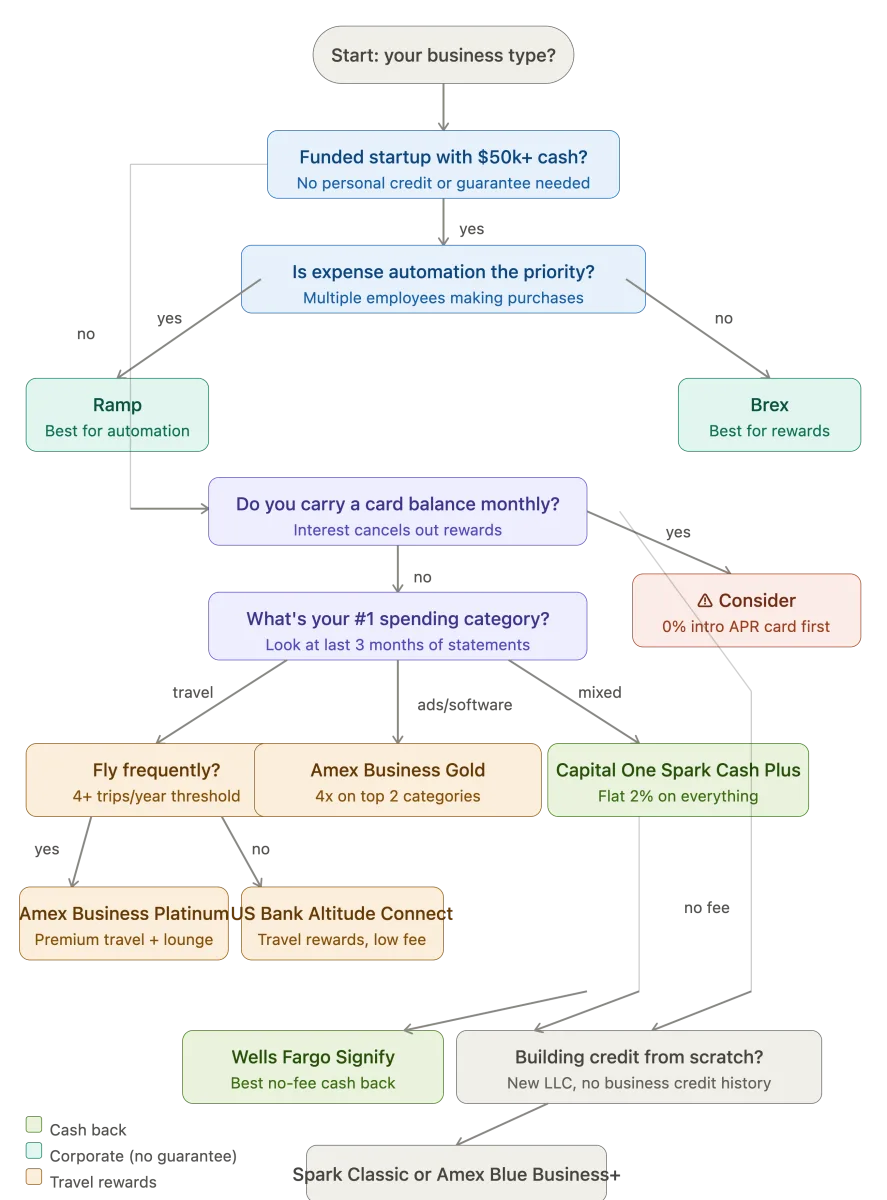
Rather than a single "best" pick, here's a practical decision tree based on the research above:
Funded startup with no credit history and a team to manage:
→ Brex Corporate Card (no personal guarantee, cash-balance underwriting, strong team controls)
→ Or Ramp Corporate Card if expense automation is the priority over rewards
Small business owner who wants simple cash back with no annual fee:
→ Wells Fargo Signify Business Cash Card
→ Or Bank of America Business Advantage Customized Cash Rewards if you have a predictable top spending category
High-spend business that wants flat-rate cash back:
→ Capital One Spark Cash Plus (unlimited 2% on everything; the $150 annual fee pays for itself at ~$7,500 in annual spend above a no-fee flat-rate card)
Frequent business traveler:
→ Amex Business Platinum for premium travel benefits
→ U.S. Bank Business Altitude Connect if you want travel rewards without a high annual fee in year one
Professional services firm with predictable high-spend categories:
→ American Express Business Gold Card (4X on top two categories, up to $150,000/year)
New LLC or business rebuilding credit:
→ Capital One Spark Classic or Amex Blue Business Plus
Related reading:
If your business is still growing its financial foundation, our guides on best student credit cards for those with no credit history and best budgeting apps in 2026 cover complementary tools. For businesses thinking about long-term financial planning, the comparison of robo-advisors vs. financial advisors is worth reading alongside this guide.
How This Guide Was Researched
This guide is based on publicly available card terms, data from industry sources including WalletHub, CreditCards.com, Forbes Advisor, SwipeSum, Aspire, and Slash, and verified customer feedback aggregated from multiple sources. It does not reflect hands-on card testing by Grounded Pick. Card terms, rates, and offers change frequently — verify current terms directly with each issuer before applying.
Reviewed by the Grounded Pick editorial team. Grounded Pick may earn a commission from purchases made through links on this page. This article was drafted with AI assistance and fact-checked by our editorial team before publishing.
Discussion
No comments yet. Be the first to share your thoughts.