

This guide is based on manufacturer specifications, market research reports, and verified industry data. It does not reflect hands-on platform testing by Grounded Pick. Grounded Pick may earn a commission from purchases made through links on this page — commissions are applied only after editorial assessment is complete.
TL;DR — What You Need to Know in 60 Seconds
- The most expensive e-learning mistake isn't picking the wrong platform — it's picking the wrong category. An LMS and an LXP solve fundamentally different problems.
- LMS = administrator-controlled. Assigns, tracks, and enforces. Best for compliance and regulated industries.
- LXP = learner-driven. Recommends and personalizes. Best for upskilling and retention.
- Licensing is only 40–60% of true 3-year costs. Implementation, content, and admin labor account for the rest.
- AI features vary wildly. Adaptive learning is real; "AI personalization" that's actually rule-based filtering is not.
- Your buyer category determines which 70% of the market you can eliminate immediately. See the Five Buyer Categories section.
Introduction: Why Every E-Learning "Best Of" List Gets It Wrong
Most "best e-learning platforms 2026" lists share the same structural flaw: they rank platforms against each other as if all buyers have the same need. They don't.
A healthcare compliance officer buying for 2,000 nurses needs mandatory course completion with audit-ready logs. A startup L&D manager buying for 80 engineers needs a platform that developers will actually log into voluntarily. A SaaS company training external customers needs branded portals and payment processing. These aren't variations of the same problem — they're completely different problems.
This guide doesn't rank platforms against each other. It gives you a map of the terrain first — category differences, real cost structures, AI claims worth trusting versus interrogating, and a buyer classification framework that eliminates most of the market before you talk to a single vendor.
Here's what makes this guide different from the others you've read: we start with the decision that saves or costs you the most money, and it has nothing to do with features.
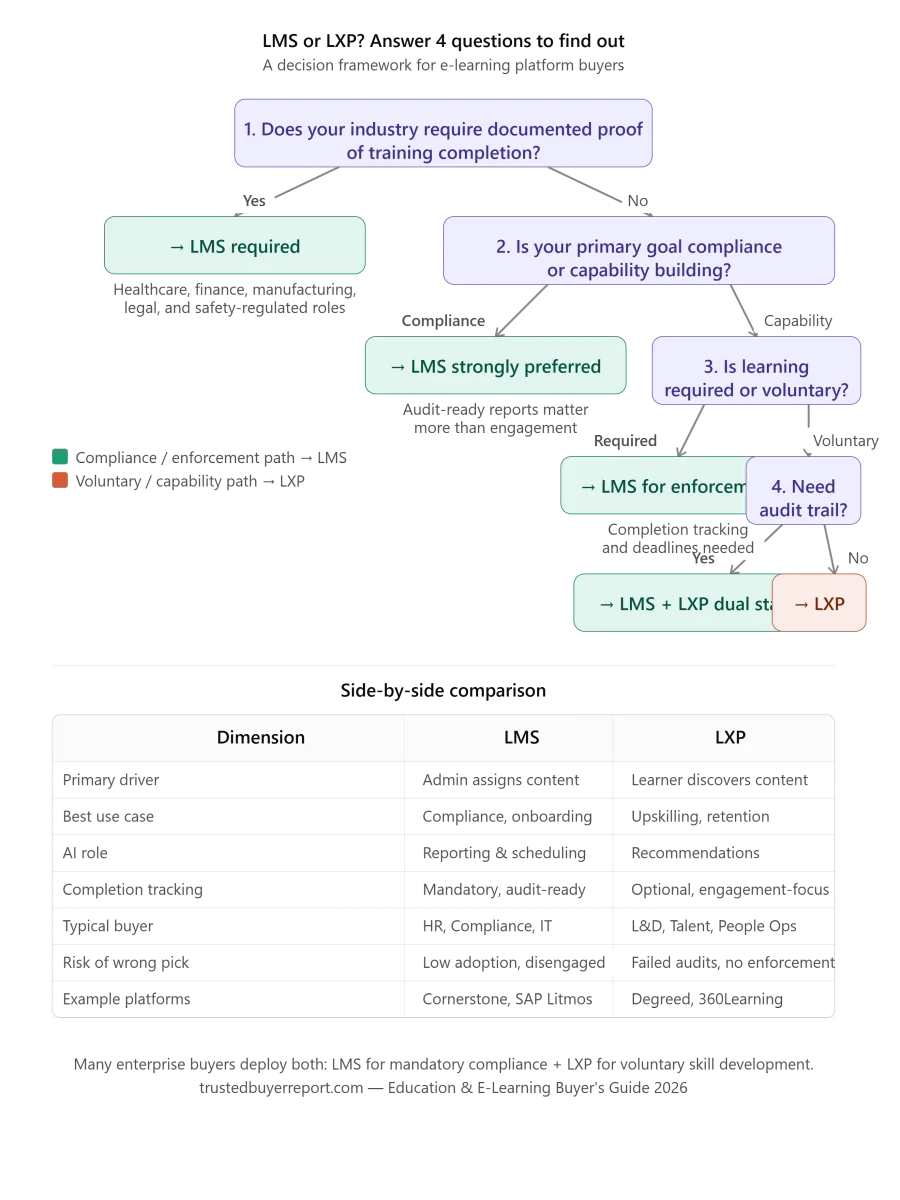
LMS vs. LXP in 2026: The Comparison That Matters Before Anything Else

The short answer: An LMS controls what learners do. An LXP suggests what learners might want. Choose based on whether your learning culture is top-down or self-directed — not based on a feature checklist.
The single most expensive mistake corporate buyers make in e-learning is purchasing the wrong category of tool, not the wrong brand within a category. Learning Management Systems (LMS) and Learning Experience Platforms (LXP) are built on fundamentally different philosophies, and confusing them wastes budget, implementation effort, and user adoption.
What Is an LMS?
An LMS is administrator-driven. It pushes structured curricula to learners, tracks completions, enforces deadlines, and generates compliance reports. Think of it as a digital classroom where the instructor controls what gets taught, when, and in what sequence.
Platforms like Cornerstone OnDemand, SAP Litmos, and Docebo (in LMS configuration) operate this way. If you work in healthcare, finance, or any regulated industry where you must demonstrate that Employee X completed Safety Training Y on Date Z, an LMS isn't optional — it's the compliance infrastructure your audits depend on.
What Is an LXP?
An LXP is learner-driven. It uses AI to surface content relevant to a learner's role, behavior patterns, and stated goals. Instead of pushing a curriculum, it pulls learners toward content they're likely to find useful.
Platforms like Degreed, EdCast (now part of Cornerstone), and 360Learning lean into this model. The tradeoff is real: you gain engagement and self-direction, but you lose the enforcement and audit trail that compliance-heavy environments require.
According to the Give River Learning & Development Tools Guide, 49% of professionals agree that aligning L&D with business goals is essential — yet many organizations still report low platform adoption. The most common root cause isn't poor content. It's category mismatch: an LXP deployed in a culture that needed enforcement, or an LMS deployed in a culture that needed autonomy.
LMS vs. LXP: Side-by-Side
| Dimension | LMS | LXP |
|---|---|---|
| Primary driver | Administrator assigns content | Learner discovers content |
| Best use case | Compliance, onboarding, certification | Upskilling, career development, retention |
| AI role | Reporting and scheduling | Recommendations and personalization |
| Completion tracking | Mandatory, audit-ready | Optional, engagement-focused |
| Typical buyer | HR, Compliance, IT | L&D, Talent, People Ops |
| Risk of wrong choice | Low adoption, disengaged learners | Failed audits, no enforcement |
The 2026 Reality: Many Enterprise Buyers Deploy Both
In practice, many enterprise buyers in 2026 run both in tandem: an LMS for mandatory onboarding and regulatory training, an LXP for voluntary skill development. A mid-size tech company might use Workday Learning as its LMS backbone for new-hire compliance and layer Degreed on top for engineers who want to self-direct their growth.
This dual-stack approach is increasingly common — but it doubles the integration and administration burden. Factor that into your total cost of ownership calculation before going this route.
Hybrid platforms are also blurring the line. Vendors like TalentLMS and Absorb LMS have added recommendation engines and social learning features traditionally associated with LXPs. This makes reading feature checklists less useful than asking one foundational question: does this platform's default experience assume the administrator knows what learners need, or does it assume learners know best?
The 2026 E-Learning Market: What the Numbers Actually Tell Buyers
The short answer: Every major research firm agrees the market is growing at double-digit rates annually. For buyers, that means a crowded vendor landscape, ongoing consolidation, and meaningful negotiating leverage on pricing.
If you've seen wildly different market size numbers, that's not a data quality problem — it's a scope problem. Different research firms measure different slices.
- ResearchAndMarkets via Yahoo Finance valued the e-learning market at $315.1 billion in 2025, projected to reach $462.06 billion by 2031 at a 12.68% CAGR. This figure includes corporate training software, content libraries, and platform infrastructure.
- Mordor Intelligence projects a narrower range: $279.86 billion in 2026 growing to $456.92 billion by 2031 at a 10.86% CAGR.
- Statista's online education outlook focuses specifically on consumer-facing education and projects $185.71 billion in 2026 reaching $279.14 billion by 2030 at a 6.86% CAGR.
All three figures are defensible. The practical takeaway for buyers: the vendor landscape is crowded, consolidation is ongoing, and the platform you select today may look different in three years due to acquisitions or pivots. Build contract exit ramps before you sign.
One number stands out for corporate budget planning. Statista projects an average revenue per user (ARPU) of $152.94 in the online education market for 2026, according to data cited by eCare Behavioral Institute. For a 500-person organization, that's roughly $76,000 annually in per-user spend — before implementation, content creation, and integration costs.
User penetration sits at 16.8% globally in 2026, with 1.2 billion users expected by 2030 per Statista. The market is still in a growth phase, not saturation. Vendors are competing aggressively for market share — which means you have real negotiating leverage on pricing if you use it.
Who Is Actually Using E-Learning in 2026? Audience Data That Changes Platform Requirements

The short answer: Mobile isn't a nice-to-have anymore. If your learners are primarily on phones, a platform with poor mobile experience will fail regardless of desktop features.
The online education market spans corporate training, higher education, K-12, professional certification, and consumer self-improvement. Most platforms are genuinely optimized for only one or two of these segments, regardless of what their marketing pages claim.
Mobile Is a Baseline Requirement, Not a Feature
According to eSkilled AI Course Creator's e-learning statistics report, 68% of learners prefer mobile-friendly learning environments. Among adults aged 18–24, smartphone penetration has reached 98%, per Mordor Intelligence. Mobile usage exceeds 60% in some regions, according to Cozmoslabs online learning data.
If your learners are primarily on phones — field workers, early-career employees, students in emerging markets — a platform with a poor mobile experience will fail regardless of how strong its desktop feature set is. Test the mobile app before you sign a contract.
The Corporate Buyer's Primary Goal in 2026: Skill Gap Closure
For corporate buyers specifically, Mordor Intelligence cites data showing that 61% of corporate L&D professionals identify skill gap closure as their top training goal. That's a meaningful signal: the primary driver isn't compliance or cost reduction — it's capability building.
Platforms that can map learning activity to specific competency gaps are more strategically aligned with what corporate buyers actually need right now than platforms that excel primarily at completion tracking.
Regional Requirements Vary Significantly
Regional context shapes platform requirements more than most buyers anticipate. According to research cited by eCare Behavioral Institute, e-learning revenue breaks down as follows: North America ($68.84B), Europe ($43.34B), Asia ($59.90B), Middle East ($24.87B), South America ($12.64B).
If your learner population spans multiple regions, audit the platform's language support, data residency options (particularly for GDPR compliance in Europe), and mobile performance in lower-bandwidth environments before signing a contract.
The Five Buyer Categories: Which One Are You?

Identifying your buyer category before evaluating vendors eliminates roughly 70% of the market from consideration immediately. Here are the five categories that cover nearly every e-learning purchase decision in 2026.
Category 1: Enterprise L&D Buyer (500+ Employees)
You need HRIS integration (Workday, SAP, ADP), SSO, role-based reporting, and a vendor SLA with uptime guarantees. Volume licensing and admin controls are non-negotiable.
Best-fit platforms: Cornerstone OnDemand, SAP Litmos, Docebo.
What to budget for: Implementation timelines of 3–6 months. Total first-year costs significantly above the per-seat license price — see the TCO section below for the full model.
Category 2: SMB or Startup Training Buyer
You need something running in days, not months. Per-seat cost matters more than feature depth.
Best-fit platforms: TalentLMS, Thinkific, Teachable.
Hidden risk: Buying a platform you'll outgrow in 18 months. Check data export and migration options before committing. A platform that traps your content is a vendor lock-in risk.
Category 3: Academic Institution Buyer
You need LTI compliance for third-party tool integration, FERPA or GDPR-compliant student data handling, gradebook integration with your SIS, and WCAG 2.1 accessibility standards.
Best-fit platforms: Canvas, Moodle, Blackboard Ultra.
Open-source note: Moodle offers maximum customization but requires significant IT resources to maintain. Factor in IT labor before assuming it's the cost-effective option.
Category 4: Individual Professional or Self-Directed Learner
You're buying a course or subscription for yourself. Admin features are irrelevant. What matters is content quality, instructor credibility, and credential recognition by employers.
Best-fit platforms: Coursera, LinkedIn Learning, Udemy.
Credential reality check: Coursera's university-backed certificates carry more external weight than Udemy's platform certificates for most professional contexts. Ask your current or target employer which credentials they recognize before paying for a program.
Category 5: Customer or Partner Education Buyer (Extended Enterprise)
This is the most underserved and misunderstood category. You're a SaaS company, manufacturer, or service provider training external customers or channel partners — not internal employees. You need external user management, branded portals, commerce and payment processing for paid certifications, and the ability to manage thousands of users you don't employ.
Standard corporate LMSs often fail here because they're built around employee records and internal HR workflows.
Best-fit platforms: Skilljar, Gainsight CE (formerly Northpass), Thought Industries.
As Talented Learning's 2026 research on customer LMS benchmarks documents, education-led growth is an emerging strategic priority — and it requires infrastructure that generic LMSs weren't designed to provide. If you're in this category and evaluating standard corporate LMS vendors, you're likely wasting evaluation time.
AI-Powered Learning in 2026: What's Real and What's Marketing Language
The short answer: Ask vendors two questions — "what data trains your recommendation engine?" and "can you demo personalization using content tagged to roles like mine?" If they can't answer both clearly, the AI claim may be overstated.
Every e-learning vendor claims AI capabilities in 2026. Most of those claims deserve scrutiny before they influence a purchase decision.
AI Features That Are Genuinely Functional in 2026
- Adaptive learning paths that adjust content sequencing based on real-time assessment performance — Degreed's skill inference engine and Coursera's adaptive quiz technology are real examples.
- Intelligent content recommendations grounded in role data and demonstrated skill gaps.
- Natural language search across large course libraries.
- Automated content generation tools that allow L&D teams to build courses from existing documentation. Rapid authoring platforms like Synthesia (AI video) and Articulate AI (course drafting) represent genuine capability here.
AI Claims Worth Interrogating
- "Personalization" that is actually rule-based filtering (if user is in Sales role, show Sales courses — that's a filter, not AI).
- "AI coaching" that resolves to a scripted chatbot with no adaptive capability.
- "Predictive analytics" that only surfaces historical completion rates without forward-looking recommendations.
The Highest-Value AI Application: Skill Intelligence
Skill intelligence — using AI to map learning content to specific job roles and competency frameworks — is the most strategically valuable AI application for corporate buyers in 2026, per Mordor Intelligence. It's also the hardest to evaluate in a demo because it requires your actual job architecture and content library to function meaningfully.
Ask vendors: What data trains your recommendation engine? What is the minimum content volume for recommendations to produce meaningful variance? Can you show a demo using content tagged to roles similar to mine?
The Credentialing Opportunity: Micro-Credentials and Portability
Mordor Intelligence cites UNESCO IESALC research showing 81% of executives believe micro-credentials ease hiring decisions. AI-assisted credential mapping — automatically connecting completed micro-credentials to open job requirements — is a high-value feature for both academic and corporate buyers.
Ask whether the platform supports Open Badges 3.0 or Verifiable Credentials standards, which enable portable, employer-verifiable digital credentials rather than PDF certificates that anyone can screenshot and fake.
Total Cost of Ownership: The Budget Calculation Most Buyers Get Wrong

The short answer: Licensing cost is typically only 40–60% of the true three-year cost. The rest comes from sources that don't appear on the vendor's pricing page.
Here's what the real cost breakdown looks like for a 500-person corporate LMS deployment:
The Hidden Cost Categories
Implementation and configuration Enterprise LMS deployments routinely require 200–400 hours of IT and L&D staff time for initial setup, SSO configuration, and HRIS integration. At a fully-loaded internal labor rate of $75–$125/hour, that's $15,000–$50,000 before a single course is created.
Content migration If you're moving from an existing platform, expect to audit, reformat, and retest every SCORM or xAPI package. Automated migration tools exist but rarely handle edge cases cleanly — budget time, not just money.
Content creation and content library subscriptions A platform without content is infrastructure without a purpose. Budget for either a content library subscription — LinkedIn Learning, Coursera for Business, Pluralsight — or internal authoring tool licenses (Articulate 360 runs approximately $1,299/user/year; Adobe Captivate is priced separately).
Ongoing admin labor Someone has to manage user enrollment, troubleshoot access issues, update courses, and generate reports. For a 500-person deployment, budget 0.25–0.5 FTE of ongoing L&D admin time.
Renewal pricing Many vendors offer discounted Year 1 pricing that normalizes upward at renewal. Get Year 2 and Year 3 pricing in writing before signing. This is non-negotiable.
Integration development If your LMS needs to push completion data to your HRIS, CRM, or performance management system via API, custom integration work can cost $5,000–$25,000 depending on complexity. Ask vendors upfront which integrations are native versus requiring custom API work.
Three-Year TCO Model: 500-Person Corporate LMS

| Cost Category | Three-Year Total |
|---|---|
| Licensing ($152.94 ARPU × 500 users × 3 years) | ~$229,410 |
| Implementation and configuration | $30,000 |
| Content library subscriptions | $45,000 |
| Ongoing admin labor (0.3 FTE × $75K/year × 3 years) | $67,500 |
| Integration development | $15,000 |
| Estimated 3-Year Total | ~$386,910 |
This model suggests that licensing accounts for roughly 59% of true three-year cost. Build a similar model with your actual figures before you negotiate — and use it to evaluate whether a more expensive platform with better native integrations might actually cost less over the full horizon.
Platform Selection Checklist: Questions to Ask Before You Sign
Before committing to any e-learning platform in 2026, work through these questions with each vendor:
Category fit
- Does this platform's default experience assume the administrator or the learner is in control?
- Is this platform optimized for our primary use case (compliance, upskilling, customer education)?
Mobile experience
- What percentage of your current customers' users access the platform primarily on mobile?
- Let me see a live demo of the learner experience on an Android phone, not just an iPhone.
AI capabilities
- What specific data trains your recommendation engine?
- What is the minimum content volume for recommendations to produce meaningful variance?
- Is the "personalization" feature AI-driven or rule-based filtering?
Integration depth
- Which HRIS integrations are native vs. requiring custom API work?
- What does a typical integration project cost and take to implement?
Pricing transparency
- What is the Year 2 and Year 3 renewal price in writing?
- Are there any per-feature or per-admin charges not in the base pricing?
Credential standards
- Do you support Open Badges 3.0 or Verifiable Credentials for portable digital credentials?
Data and compliance
- Where is learner data stored, and what are the data residency options for international deployments?
- What WCAG accessibility standard does the platform currently meet?
Frequently Asked Questions
What is the difference between an LMS and an LXP?
An LMS (Learning Management System) is administrator-controlled software designed to assign structured training, track completions, and enforce compliance requirements. An LXP (Learning Experience Platform) is learner-driven software that uses AI to recommend content based on individual role and behavior. The key distinction is control: an LMS pushes content to learners; an LXP pulls learners toward content they're likely to want. Many large organizations deploy both in tandem — an LMS for mandatory compliance training and an LXP for voluntary skill development.
How much does an e-learning platform cost for a 500-person company?
Licensing typically costs approximately $150–$200 per user per year, or $75,000–$100,000 annually for 500 users. However, total three-year cost of ownership is significantly higher when you factor in implementation ($15,000–$50,000), content library subscriptions ($15,000/year+), integration development ($5,000–$25,000), and ongoing admin labor. A realistic three-year TCO for a 500-person corporate LMS is $300,000–$450,000 depending on platform and organizational complexity — roughly double the licensing cost alone.
Which e-learning platform is best for compliance training?
For compliance-heavy environments — healthcare, finance, manufacturing, or any regulated industry — the defining requirements are mandatory completion tracking, audit-ready reporting, and integration with your HRIS. Platforms built specifically for this use case include Cornerstone OnDemand, SAP Litmos, and Docebo. The key question to ask is whether the platform can generate the specific compliance reports your regulatory framework requires, not just generic completion reports.
Is Coursera better than Udemy for professional development?
For most professional development goals, Coursera's university-backed certificates carry more external credibility than Udemy's platform certificates — particularly for roles in technology, business, and data science where employers recognize specific credential issuers. Udemy's strength is breadth, lower per-course pricing, and speed: courses are published faster than Coursera's review-gated programs. The right choice depends on whether employer or credential recognizability matters more than cost and content variety for your specific situation.
What should I look for in an e-learning platform for customer training?
Customer or partner training (often called "extended enterprise" or "external training") requires different capabilities than internal employee training. Key requirements include external user management without HR system dependency, branded learner portals, e-commerce functionality for paid certifications, and the ability to manage users across multiple external organizations. Standard corporate LMS platforms are typically not built for this use case. Purpose-built platforms for customer education include Skilljar, Gainsight CE (formerly Northpass), and Thought Industries.
What does 'AI-powered learning' actually mean in 2026?
"AI-powered" covers a wide range of actual capability. Genuine AI features include adaptive learning paths that adjust sequencing based on assessment performance, intelligent content recommendations grounded in role and skill data, and natural language search across course libraries. Marketing claims worth questioning include "personalization" that is actually rule-based filtering, "AI coaching" that resolves to a scripted chatbot, and "predictive analytics" limited to historical completion rates. Before being influenced by an AI feature claim, ask the vendor: what specific data trains the model, and can they demo it using content similar to yours?
Discussion
No comments yet. Be the first to share your thoughts.