
This guide is based on manufacturer data, published industry reports, and aggregated verified customer feedback. It does not reflect hands-on testing by Grounded Pick. Sources are cited throughout. Read our methodology →
TL;DR — What to Know Before You Buy Flowers or Gifts in 2026
- The U.S. floral gifting market is on track to grow from $8.55B in 2025 to $11.06B by 2031 — more vendors, more promises, and more room for disappointment.
- Four variables determine whether a floral gift succeeds: freshness, arrangement style fit, delivery timing, and packaging integrity. Miss one, and the whole gift can unravel.
- Farm-direct services (The Bouqs Co., UrbanStems) generally deliver fresher flowers; relay networks (1-800-Flowers, FTD, Teleflora) offer broader same-day coverage. Neither is always better — it depends on your situation.
- For any occasion that actually matters, order 2–3 days in advance. Same-day delivery is a safety net, not a strategy.
- Local independent florists still win for weddings, sympathy arrangements, and high-stakes occasions. No algorithm replaces a conversation.
Why Buying Flowers and Gifts in 2026 Is More Complicated Than It Looks
Here is a number that should reframe how you think about ordering flowers: the U.S. floral gifting market is projected to grow from $8.55 billion in 2025 to $11.06 billion by 2031, at a compound annual growth rate of 5.25%, according to the United States Floral Gifting Market Report 2026–2031 (GlobeNewswire). More money. More vendors. More delivery promises. And yet the most common complaints — wilted stems, wrong colors, late arrivals, arrangements that look nothing like the website photo — haven't gone away.
The traditional florists segment tells a more complicated story. IBISWorld's 2026 U.S. Florists Industry Analysis puts industry revenue at approximately $4.9 billion in 2026, down about 0.2% year over year. Supermarkets, DIY culture, and farm-direct online vendors are steadily undercutting simple bouquet sales, forcing traditional florists to specialize or move upmarket to survive.
The competitive field has also expanded dramatically. A buyer in 2019 might have compared two or three national vendors. In 2026, that same buyer faces more than 20 national brands — including 1-800-Flowers.com (the largest market-share holder in the U.S. florists industry per IBISWorld), FTD, Teleflora, The Bouqs Co., and UrbanStems — alongside supermarket floral departments, farm-direct subscription services, and social-commerce pop-ups discovered through Instagram and Pinterest.
Same-day delivery, powered by third-party logistics partners like DoorDash and Walmart GoLocal, has become a standard marketing promise rather than a premium feature. That shift raises expectations without uniformly improving outcomes. One telling market signal: The Bouqs Company raised $2.1 million through a Regulation CF crowdfunding campaign in 2026 to fund brick-and-mortar expansion, per ResearchAndMarkets. Even brands built entirely online are rethinking the model — which tells you where the friction points still are.
What Actually Makes a Flower Gift Succeed or Fail?
Most buying guides jump straight to vendor rankings. This one starts somewhere more useful: the recipient's experience.
Four variables determine whether a flower gift lands or disappoints:
- Flower freshness and vase life
- Arrangement style alignment with the recipient's taste
- Delivery timing accuracy
- Packaging integrity on arrival
Get all four right and the gift works. Miss one and the whole thing can unravel.
Freshness is the professional benchmark
When New Bloom Solutions' 2026 Floral Industry Report asked florists to rank their most important supplier criteria, quality and vase life came first at 30.8% — ahead of price and ahead of long-term relationships (23.1%). Professional florists who handle flowers every day prioritize longevity above everything else. Buyers should apply the same standard.
Style alignment is increasingly non-negotiable
Today's floral buyer is more visually aware and more selective than buyers even a few years ago, according to Thursd.com's 2026 consumer trends analysis. A recipient who follows floral design accounts on social media will immediately notice whether an arrangement looks curated and personal or mass-produced and generic. The same $75 spend can feel thoughtful or lazy depending entirely on whether the arrangement matches the recipient's aesthetic.
Packaging and last-mile delivery are where online orders most commonly fail
Flowers are perishable. An arrangement that sits in a warm delivery van for three hours while a driver completes 15 other stops will arrive in worse condition than one delivered directly from the florist's shop. This is not a hypothetical — it is the structural reality of how relay-network and gig-logistics delivery works, particularly during peak holiday periods.
Context matters more than ever
Flowers are increasingly bought for everyday living — home offices, kitchens, cafés — rather than exclusively for major occasions, according to Thursd.com. That shift changes what "a good gift" means. A dramatic occasion-appropriate arrangement is right for a birthday or anniversary. A smaller, quietly beautiful arrangement that suits someone's home aesthetic is right for a "thinking of you" moment. Buying without considering context is how well-intentioned gifts miss.
Flower Types and Vase Life: Matching the Bloom to the Moment
Understanding vase life before you buy is one of the highest-leverage decisions a gifter can make. A longer-lasting flower is a longer-lasting impression.
Roses dominate the gifting market for reasons that go beyond tradition. New Bloom Solutions reports that nearly 70% of florists identified roses as their top-performing Valentine's product. Classic red remains the dominant color preference, but mixed arrangements combining red with blush, white, or burgundy are showing strong demand growth — a signal that buyers want something slightly more curated than a dozen identical stems.
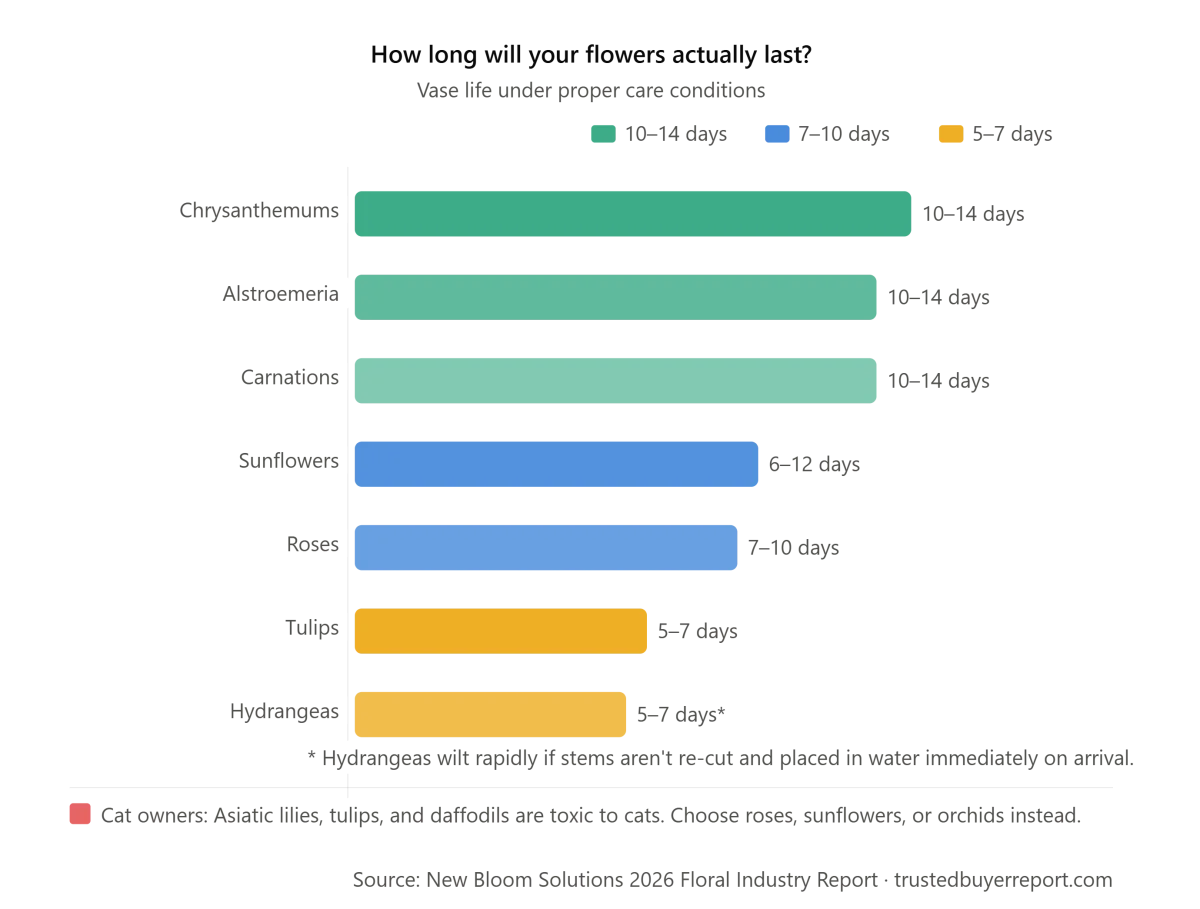
Here is a practical vase-life hierarchy to inform your purchase:
| Flower | Vase Life | Notes |
|---|---|---|
| Chrysanthemums & Carnations | 10–14 days | Underrated longevity; carnations have shed their dated reputation |
| Alstroemeria (Peruvian Lily) | 10–14 days | Excellent value; holds color well in mixed arrangements |
| Sunflowers | 6–12 days | Buy with petals just opening for maximum life |
| Roses | 7–10 days | Require fresh water, trimmed stems, cool location away from direct sun and fruit |
| Lilies | 7–10 days | Note: Asiatic and Oriental lilies are toxic to cats — check if recipient has pets |
| Tulips | 5–7 days | Continue growing after cutting and lean toward light; charming or annoying depending on the recipient |
| Hydrangeas | 5–7 days | Highly sensitive to dehydration; stems must be re-cut and placed in water immediately on arrival |
Specialty varieties represent a growing segment. The global cut flowers market reached $34.94 billion in 2025 and is expected to grow to $42.98 billion by 2030 at a CAGR of 4.9%, per The Business Research Company, with specialty and rare varieties called out as a key demand driver. Protea, ranunculus, garden roses, peonies, and lisianthus are the varieties most likely to make a recipient who follows floral design content genuinely stop and notice. They cost more and have shorter availability windows, but the visual impact is proportionally higher.
Quality signals you can assess before purchasing in person: firm, closed or just-opening buds; vibrant leaf color with no yellowing; clean, non-slimy stems; no bruising on petals; a fresh scent rather than a fermented or musty one. For online orders, the equivalent signals are vendor transparency about sourcing, clear photos of actual arrangements (not styled stock images), and customer reviews that specifically mention arrival condition.
Understanding the Vendor Landscape: National Chains, Local Florists, and Farm-Direct Services
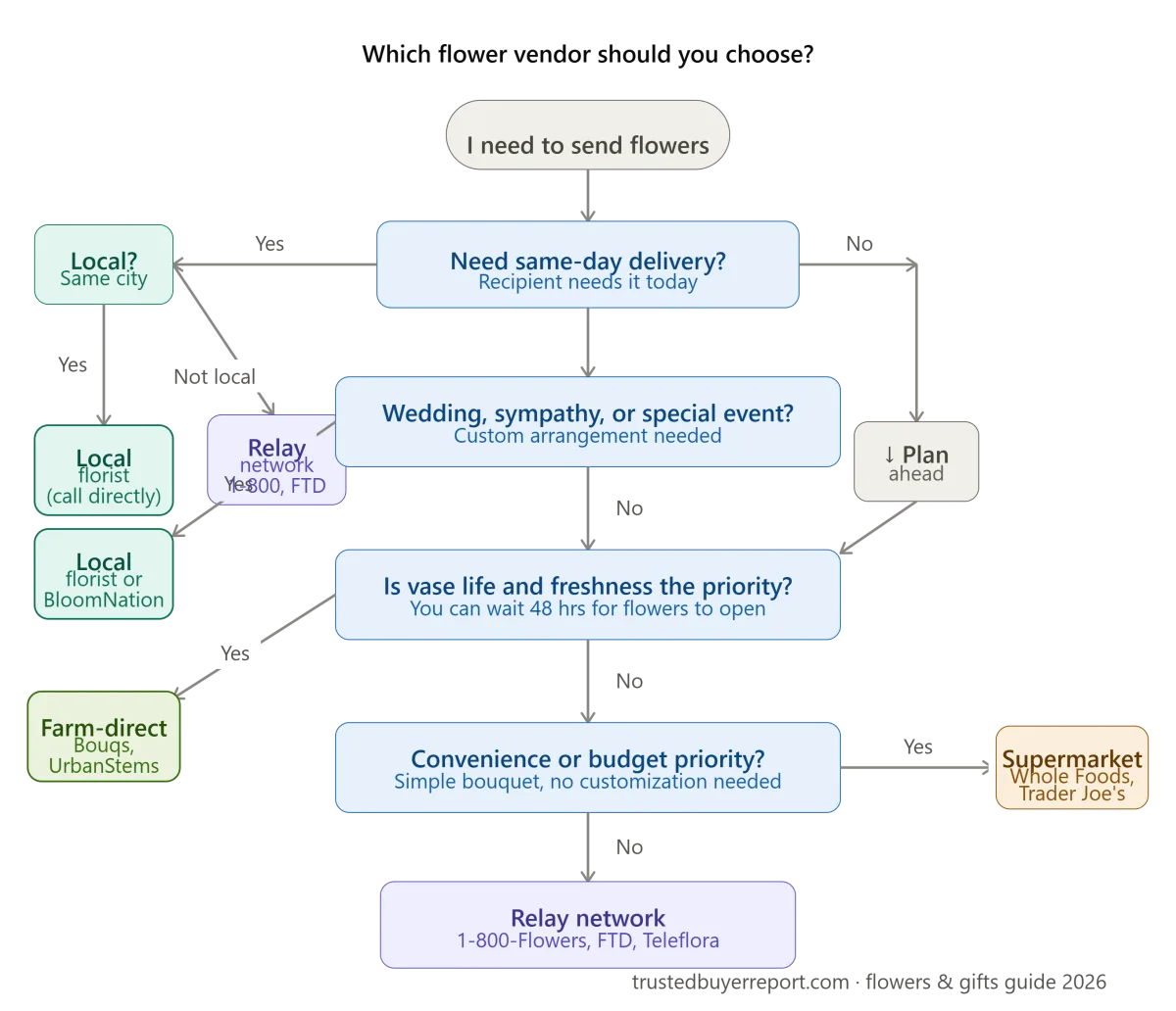
The single most useful thing a buyer can understand about the 2026 floral market: different vendor types operate on fundamentally different models, and each model has a specific situation where it outperforms the others. Choosing the wrong model for your situation is the most common source of disappointment.
National Relay Networks: FTD, Teleflora, 1-800-Flowers.com
These vendors operate a hub-and-spoke model: you place an order centrally, and it is fulfilled by a local florist affiliate in the recipient's area. The central vendor sets a price and style standard; the affiliate florist interprets it with whatever inventory they have on hand.
Quality depends heavily on which affiliate fulfills your specific order. In a zip code with a strong affiliate partner, the experience can be excellent. In a zip code with a weaker one, the same order produces a noticeably different result.
1-800-Flowers.com was recognized among America's Most Trustworthy Companies by Newsweek for 2024, per ResearchAndMarkets. That credibility is real — but it does not eliminate affiliate variability.
- Best for: Sending to addresses you cannot easily reach yourself; recipients in well-served urban zip codes; situations where a local florist is unknown.
- Weakest for: High-customization requests; rural delivery; situations where arrangement consistency is critical.
Farm-Direct and Digitally Native Brands: The Bouqs Co., UrbanStems, Farmgirl Flowers, BloomsyBox
These vendors source directly from farms — often in Ecuador or Colombia — and ship flowers in bud via overnight or two-day cold-chain delivery. The tradeoff is clear: flowers arrive fresher and last longer, but they need 24–48 hours to open fully. This is not a defect; it is the model.
The Bouqs Co. partnered with Roadie in 2025 to expand same-day delivery capacity, narrowing the speed gap with relay networks. UrbanStems and Farmgirl Flowers operate similarly, with strong reputations for arrangement quality and honest photography.
- Best for: Buyers who prioritize freshness and vase life; subscription gifting; recipients who appreciate distinctive, curated arrangements.
- Weakest for: True same-day delivery needs; last-minute orders.
For a full, side-by-side comparison of these services including pricing tiers and delivery windows, see our dedicated Best Online Flower Delivery Services 2026 guide.
Local Independent Florists
For complex arrangements, same-day local delivery, and situations where a conversation about the recipient matters, a local independent florist is still the strongest option. You can describe the recipient's home aesthetic, mention their favorite colors, specify a budget, and get something genuinely custom. BloomNation functions as a useful middle ground — it connects buyers directly with vetted local florists through an online interface, combining the convenience of digital ordering with local fulfillment quality.
- Best for: Weddings, sympathy arrangements, high-stakes occasions, and local same-day delivery.
- Weakest for: Sending to distant addresses without a known local florist.
Supermarket Floral Departments
Walmart, Trader Joe's, and Whole Foods offer competitive pricing and genuine convenience for simple bouquets. Vase life is typically shorter due to supply chain handling, and customization is minimal.
- Best for: Spontaneous "thinking of you" gestures picked up in person.
- Weakest for: Meaningful gifting occasions.
Same-Day Delivery in 2026: What It Actually Means and When to Trust It
Same-day delivery is the most heavily marketed feature in the 2026 floral market — and the one most likely to create problems if you rely on it without understanding its mechanics.
The infrastructure reality: Most vendors' same-day promises depend on third-party logistics — DoorDash, Walmart GoLocal, and similar platforms, per IBISWorld. This is shared infrastructure, not a proprietary capability. A vendor advertising "same-day delivery" is largely dependent on gig driver availability in your specific area at that specific moment.
Coverage gaps are real. Rural and semi-rural zip codes frequently fall outside same-day zones even when the vendor's website accepts the order without flagging a problem. If you are sending to a less-populated area, call or chat with the vendor before placing the order to confirm actual availability.
Cutoff times compress during peak periods. Order cutoffs typically run 12 p.m. to 3 p.m. local time. But on Valentine's Day, many vendors move these earlier or suspend same-day guarantees entirely. According to IntoTheMinds' Valentine's Day statistics, 30% of male purchases are made on the day itself — vendors know this and capacity constraints are real. The buyer who waits until 2 p.m. on February 14th to order same-day delivery is the buyer most likely to be disappointed.
Real-time order tracking is a meaningful quality signal. IBISWorld notes that AI tools and real-time tracking are sharpening service delivery across the industry. A vendor that offers genuine tracking — not just a confirmation email followed by silence — has invested in last-mile visibility, which correlates with operational seriousness.
The practical rule: For any occasion that matters, order 2–3 days in advance from a reputable vendor. Same-day delivery is a useful safety net for genuinely last-minute situations — not an optimal strategy for important moments.
Want to know whether prices typically dip before or after a major floral holiday? Our Price Trend Analyzer can show you historical pricing patterns for major flower delivery services.
Occasion-Matching Guide: Choosing the Right Flowers and Gifts
Different occasions call for different strategies. Here is a practical breakdown:
Valentine's Day
Red roses remain the statistically dominant choice — nearly 70% of florists report them as top sellers. The modern upgrade is a mixed arrangement that incorporates red with blush, white, or burgundy rather than a uniform dozen.
Order by February 11th at the latest. If you are ordering on February 14th itself, use a local florist directly rather than a national relay network, and call rather than ordering online to confirm availability.
Mother's Day
The second-largest floral holiday in the U.S. Mixed seasonal arrangements, potted plants, and subscription boxes (BloomsyBox, The Bouqs Co.'s subscription tier) are strong alternatives for recipients who prefer something longer-lasting. Potted orchids, succulents, and herb gardens have grown in popularity precisely because they outlast a cut arrangement by weeks or months.
Birthdays
Personality-matched arrangements outperform generic bouquets. Before ordering, spend 30 seconds scrolling the recipient's social feed — their home aesthetic and color preferences are usually visible. A recipient who decorates in neutrals will respond differently to a bright mixed arrangement than someone whose kitchen is full of color.
Weddings and Events
Wedding decoration spending is one of the primary growth drivers for the global cut flowers market, per The Business Research Company. For wedding florals, plan 3–6 months ahead and work directly with a local florist rather than a national relay network. Budget $45–$85 per centerpiece as a realistic baseline for quality work in most U.S. markets. The complexity of wedding arrangements exceeds what relay networks handle reliably.
Sympathy and Condolence
White lilies, white roses, and subdued color palettes are the established choice for sympathy arrangements. Avoid bold or bright colors. Potted plants — particularly peace lilies — are increasingly common for sympathy gifting because they last and require minimal care from a grieving recipient.
Timing note: For sympathy arrangements, delivery to the funeral home typically needs to occur within a specific window. Confirm the delivery schedule directly with the venue and your florist.
"Just Because" / Everyday Gifting
A growing segment. Smaller, personally curated arrangements priced in the $35–$55 range outperform large dramatic bouquets here — they fit naturally into someone's home without demanding a vase and prime real estate on the dining table. Subscription services like BloomsyBox are particularly well-suited to recipients who enjoy having flowers regularly without the friction of ordering.
How to Evaluate Any Flower Vendor Before You Buy
Before placing an order with any vendor — national chain or local florist — run through these five checks:
1. Look for photos of actual arrangements, not styled stock imagery. The gap between website photography and delivered arrangement is one of the most documented complaints in floral e-commerce. A vendor that shows real, un-retouched customer photos is demonstrating honest expectations.
2. Read reviews specifically for arrival condition, not just overall satisfaction. A 4.5-star average means little if the reviews that mention delivery mention bent stems and browning edges. Filter for reviews that describe what arrived, not just the ordering experience.
3. Understand the substitution policy before you order. Most vendors reserve the right to substitute flowers of "equal or greater value" when specific varieties aren't available. This is standard practice, but it matters most during peak periods. Know what you are agreeing to.
4. Confirm same-day availability before placing the order. Especially for rural zip codes and during major gifting holidays, don't assume the website's acceptance of your order means delivery is guaranteed.
5. Check the refund/reship policy. A vendor confident in their product makes rescheduling or reshipping straightforward when something goes wrong. A vendor with a complex, heavily caveated return process often reflects a company that knows things go wrong often.
You can also use our AI Shopping Assistant to compare specific vendors side-by-side, or check customer feedback patterns across multiple sources before committing.
Non-Floral Gifts: When Flowers Aren't the Right Answer
Not every gifting occasion calls for flowers. Here are situations where alternative gifts may land better:
- The recipient doesn't have reliable home access during the day. Flowers left on a doorstep for six hours are flowers you wasted. A gift card, subscription box, or experience gift has no delivery window problem.
- The recipient has pets (particularly cats). Asiatic lilies, tulips, and several other common varieties are toxic to cats and dogs. When in doubt, opt for non-floral alternatives or confirm with your florist.
- The occasion is professional or semi-formal. A plant (succulent, potted orchid) typically reads better than a cut bouquet in a professional context — it signals care without the romantic connotation.
- You want the gift to last. A quality candle, a wine or food subscription, a personalized keepsake, or an experience gift (cooking class, spa day) will outlast any arrangement.
When flowers are right, they are hard to beat. When they are not the right fit, forcing the medium costs you both the money and the impact you intended.
Budget Guide: What Different Price Points Actually Get You
| Price Range | What to Expect | Best Vendor Type |
|---|---|---|
| Under $35 | Supermarket bouquet, 3–5 stems, shorter vase life | Grocery store; convenience only |
| $35–$60 | Decent mid-range bouquet; entry-level online vendor; limited customization | National relay or farm-direct at entry tier |
| $60–$100 | Good quality from farm-direct brand; possibility of specialty varieties; proper mixed arrangement | Farm-direct (Bouqs, UrbanStems) or local florist |
| $100–$175 | Premium arrangement; curated specialty varieties; reliable quality from reputable vendor | Farm-direct premium tier or local florist |
| $175+ | Custom artisan arrangements; rare varieties; wedding-grade design; local florist conversation | Local independent florist |
On hidden fees: Watch for service fees, delivery fees, and "vase fees" that are not included in the advertised price. A $49.99 arrangement that arrives with $22 in added fees is a $72 arrangement. Some vendors bundle these more honestly than others — always check the total at checkout before completing the order.
Frequently Asked Questions
What is the best flower delivery service for same-day delivery in 2026? Same-day delivery reliability depends heavily on your zip code. In dense urban markets, 1-800-Flowers.com, FTD, and Teleflora have the broadest affiliate networks for true same-day fulfillment. The Bouqs Co. expanded same-day capability through their Roadie partnership in 2025 and is increasingly competitive in major metro areas. For rural addresses, a local florist contacted directly is the most reliable option.
How far in advance should I order flowers for Valentine's Day? Order by February 11th for guaranteed delivery on or before Valentine's Day from any national vendor. If you must order on February 14th, contact a local florist by phone before 10 a.m. — their same-day capacity is finite and fills quickly.
Are farm-direct flowers actually better quality? Farm-direct flowers typically arrive with more remaining vase life because they bypass an intermediate distribution step. However, they arrive in bud and require 24–48 hours to open. If the gift is being delivered and the recipient expects to see an open arrangement immediately, factor this in. For subscription use or occasions where a 24-hour window exists, farm-direct consistently outperforms relay-network alternatives on freshness.
What flowers should I avoid if the recipient has cats? Avoid all lily varieties (Asiatic, Oriental, Tiger, Easter), tulips, daffodils, and hyacinths — all are toxic to cats. Safe options include roses (remove thorns), sunflowers, orchids, and snapdragons. When in doubt, ask your florist explicitly about pet safety and check the ASPCA's toxic plant list.
Is it worth paying for a subscription flower service? For recipients who regularly enjoy having flowers at home, a subscription service (BloomsyBox, The Bouqs Co., UrbanStems) typically offers better per-arrangement value than one-off orders. The real advantage is convenience and the ongoing freshness habit — most subscribers report vase life superior to what they find at supermarkets.
What's the difference between a relay network and a farm-direct florist? A relay network (FTD, Teleflora, 1-800-Flowers) takes your order centrally and passes it to a local affiliate florist for fulfillment. A farm-direct service (The Bouqs Co., UrbanStems) ships flowers straight from the growing farm to your recipient. Relay networks offer broader same-day coverage; farm-direct services offer longer vase life and more consistent arrangement quality.
The Bottom Line
The U.S. floral gifting market in 2026 offers more options than ever — which means more ways to get it exactly right, and more ways to miss. The buyers who consistently land memorable gifts share a few habits: they consider the recipient's aesthetic before choosing an arrangement, they order ahead rather than relying on same-day promises for anything important, and they match the vendor type to the specific situation rather than defaulting to whatever is advertised most aggressively.
Flowers done right are one of the most emotionally effective gifts you can give. Done carelessly, they are just an expensive way to produce a vase of wilting stems.
Use the guides in this cluster to go deeper on the specific decisions that matter most to you:
- → Best Online Flower Delivery Services 2026 — head-to-head comparison of the top vendors, scored by arrival condition, photography honesty, and delivery accuracy.
How This Guide Was Researched
This guide aggregates data from published industry reports (GlobeNewswire, IBISWorld, The Business Research Company, ResearchAndMarkets), trade publications (New Bloom Solutions, Thursd.com), and consumer behavior data (IntoTheMinds). It does not reflect hands-on testing by Grounded Pick. All claims are cited to their sources. Read our full methodology →
This article was drafted with AI assistance and fact-checked by our editorial team before publishing. Grounded Pick may earn a commission from purchases made through links on this page. Full affiliate disclosure →
Discussion
No comments yet. Be the first to share your thoughts.